Thursday, September 26, 2013

What the Vander World Eats in a Week

Have you seen the photos from the book Hungry Planet: What the World Eats? It was interesting to look at the pictures and see the variety in amounts of food, what kinds of food, and how it is packaged and served. I declared myself too lazy to make a photo of one week's worth of food for our family. And then to prove myself wrong I did it. Kind of.
I probably didn't do the most accurate job, since we also eat items from the pantry and the freezer. I normally "stock up" on items like pasta or dried beans all at one time, so I didn't need those things this week. 

Pictured is one grocery trip to Winco (which I do weekly), plus 1 carton of eggs from the fridge and the  metal bowl of produce showing the types of things we eat from the garden lately: beans, kale, onions, tomatoes, and cabbage. We harvest more than that in a week but I didn't have room for it in the bowl. The eggs are almost always from our chickens but they are molting and not laying as much, so we bought a dozen store eggs last week.

Don't see the bread? There are wheat berries in the back left plastic bag that get ground and used in pizza crust and bread.

We also occasionally buy food at the NW Regional Food Hub or order foods from the Azure Standard food co-op through them.

I spent $42.50 at Winco today, which is pretty typical. Mint.com says that I spend $232 on groceries per month on average (based on the last 12 months). That number doesn't include chicken feed, garden supplies, aquaponics supplies and fish food, or food storage supplies like canning equipment. And it probably leaves out an occasional small purchase made with cash that doesn't get recorded by Mint.

We're blessed with access to a lot of fresh fruit and lots of sunshine to grow food in our region!

I'd love to see your picture of food for a week!

Tuesday, September 10, 2013

Universal Preschool: A Stifling "Freebie"

In Washington state, there is not yet universal free preschool, but I predict it will be considered soon. Since my kids are of preschool age or will be soon, and my home state of Iowa is in the process of implementing government-funded universal optional preschool, I became interested in this topic.

Recently I read an article entitled More Government Preschool: An Expensive and Unnecessary Middle-Class Subsidy. I found the article a tad repetitive, and it didn't really address whether or not preschool has any academic benefit. But you can scan the main points in the top right, and I found the last 3 paragraphs worth reading.

If you would like to read more research on this topic, read this report summarizing the findings of many studies about preschool and all-day kindergarten.

The main reasons that I am against legislation for universal preschool are:

  • I don't want to pay for it with my taxes. Flawed as the public school system can be, I am somewhat OK with my taxes paying for public education that I don't plan to utilize, because it is in the best interest of the country to have educated citizens. Given that preschool has no proven educational benefit for the average kid, it seems like a waste of money. High taxes makes it hard for me and others like me to choose to work part-time (or no paid work) and focus on caring for our own children.
  • Discourages innovation and healthy variety in education. I like research, but there is not one proven "right way" to do education. Many typical private preschools would be edged out of business by government-funded ones, and that is too bad. It is the non-typical ones I'd be especially sad about: completely outdoor preschools? Montessori? Groups of families that get together for Joy School? ECHO (a Christian homeschool co-op) that Toby attends? Boldly Christ-centered preschools? They'd likely have trouble aligning with the regulations and "academic standards" required to get government funding, and the number of people willing to pay privately would go down.
  • It's deceptively hard to say no to. Everyone wants free. Most middle class people feel that money is tight; sometimes it is. Many families desire preschool for one reason or another (either they believe it is academically or socially beneficial, fun, or would serve as child-care for a parent to take on a part-time or full-time job). Legislators don't know much about education and don't want to look bad by voting against something that will supposedly help children and families. I anticipate that universal optional preschool would face very little political or grassroots opposition.
  • Honestly, I'm not convinced that it will always be optional. Will future families have to fill out special paperwork to "homeschool" their 3 or 4 year olds and prove that they are providing quality academics at home? I hope not, but the trend seems to be strongly towards more paperwork required, lowering the age of compulsory education, etc. 

Watch the legislation in your state (and at the federal level), stay informed even if you don't have preschool children, and continue to ask thoughtful questions about how we can best support families with small children (how about universal someone-comes-and-cleans-my-house-weekly...just kidding).

I am not categorically anti-preschool. I don't believe it is necessary or an academic boost. We live far from extended family, 15 minute drive or more from most church friends, and almost all the homes on our street are retired people. It can be kind of isolating. I do like the opportunity for Toby to get to know other kids and try new activities; he attends preschool for 3 hours a week for part of the year while I teach music classes. Other families might have other reasons for choosing preschool or no formal preschool and it is their choice: I oppose universal "free" preschool because I want them to continue to have a variety of choices.

Saturday, September 07, 2013

Fall 2013 Rotating Meal Plan

Ta-da! Fall meal plan. I put jackets on the kids outside yesterday, so it is officially fall at our house.


I hope to have a good supply of kale and cabbage from the garden, and I can use fresh, frozen, or canned tomatoes from the garden or greenhouse in soup or pizza. Fresh basil tastes great on pizza, and gives us a break (a free and healthy one, too!) from other toppings like pepperoni and Canadian bacon.

It is not on the meal plan, but on Sunday night after church we usually have homemade chocolate pudding or chips and salsa. Friday nights is always pizza, and popcorn during our movie. Do you have any meals or snacks that are a weekly family tradition?


Week A
Chicken pesto pasta
Enchiladas
Kale/Potatoes and sausage or other meat
Sourdough Pizza
Breakfast
Teriyaki Chicken

Week B
Soup and bread/biscuits
Egg casserole
Sourdough Pizza
Mac 'n cheese
Pork Chops

Click here for a downloadable pdf one-page version of this meal plan for your fridge.

Wednesday, September 04, 2013

New Items @ Hammer & Thread

I hope you aren't actually Christmas shopping yet, but if you are tucking away ideas in the back of your head I guess I will forgive you. And give you some brainstorms!

Today I noticed the wall hanging tile letters at Hammer & Thread thread. I had heard about them but hadn't seen the pictures yet. I think they would look great hanging in a classroom, living room, or almost anywhere. If I had a staircase I would want to hang our family's names in Scrabble tiles with family pictures arranged around it on the wall.


We enjoy our growth chart wall ruler, Heartland Strategy game (when the kids let us play games other than Busytown), and other personalized items made by Gregg (my Dad!). 

The reviews confirm what I've known for a long time: these are beautiful and special pieces that will stand out in any home.

Tuesday, August 27, 2013

M: 21 months

Buttered it myself.
 Mr. Malachi is 21 months old. His vocabulary is just exploding lately, and his favorite things include:

  • doing things himself: "No, Mom!"
  • talking about action: helping, jumping, smashing, raining
  • talking about insects and their demise: "fly? bee? swat?"
  • cooking, and talking about cooking: flip, stir, chop, slice, cut, egg, flour, hot, beeping, done
  • looking out for the interests of numero uno: me!, turn, too
  • singing along with 'Tradition' from Fiddler on the Roof: "Pa-paaaaa!!!!"
  • spending time with family: "Home! Daddy! Daddy home!!!"
He eschews the traditional "can you say _____?" and "what does the _____ say?" games, but echoes Toby's words (and attitudes...yikes!). 
Even men of action need cuddling and a book.

Thursday, July 25, 2013

Yakima Valley Pie

There are lots of tomato and zucchini pie recipes floating around out there. But if you use this recipe, you'll be able to taste the hospitality of the Yakima Valley, home of don't-leave-church-without-some-shared-produce. Thanks for the great recipe, Sandi E.! 


1 lb. ground beef                                      
1/2 cup chopped onion
1/2 tsp. salt
1/8 tsp. pepper
1 & 1/2 cup sliced zucchini
1/4 cup chopped green pepper
1 tsp. dill seed
1/4 tsp. salt
2 T. butter
1 (8 oz.) can crescent rolls
1 cup cheddar cheese
tomato slices, enough to cover pie
serve with (optional): sour cream, alfalfa sprouts 
Heat oven to 375 degrees.  In skillet, brown ground beef and onion; drain.  Stir in the 1/2 teaspoon salt and the pepper; set aside.  Saute zucchini and green pepper in butter for 5 minutes, stirring frequently.  Stir in dill seed and the 1/4 teaspoon salt.
Separate dough into 8 triangles. Place triangles in ungreased 9 inch pie pan;  press over bottom and up sides to form a crust. Spoon meat  mixture over crust. Sprinkle 1/2 cup of shredded cheese over meat mixture.  Spread zucchini mixture evenly over meat; top with tomato slices.  Bake at 375 degrees for 10 minutes. Sprinkle remaining 1/2 cup shredded cheese over tomatoes;  return to oven and bake an additional 15 minutes. Cool 5 minutes before serving.  Garnish with sour cream and alfalfa sprouts (or lettuce). Cut into wedges to serve 6  (if you're lucky!) 


P.S. I didn't actually follow the recipe for this picture. I used a sourdough pizza-type dough for the crust, and an extra-big pie pan to fit in a few more veggies.

Tuesday, July 16, 2013

Coconut Yogurt Popsicles

These popsicles were inspired by creamy sweet Mexican coconut popsicles and coconut cream pie or pudding. I also give inspiration credit to the large amounts of plain yogurt I had in my fridge and my two voracious popsicle testers.


1 c. plain yogurt
1 T. honey (warm to soften if needed)
1/2 c. shredded coconut


Stir, freeze, serve.


This was a small batch and only filled 3 of the 4 popsicle slots in my mold. Other than that, it was a hit. It had a hint of yogurt tartness so if you want it sweeter and more ice-cream-like you could start with vanilla yogurt or something already sweetened. There are also non-dairy coconut milk yogurts that might taste great as popsicles. I'd love to hear what variations you come up with!

Monday, June 17, 2013

Summer 2013 Meal Plan


It's that time of the year when we use up the strange things in our freezer and savor the first bits from the garden. We've been eating a lot of apple butter pie (I make it with just the bottom crust, like pumpkin pie) and putting kale in lots of things.

We're partway through our first rotation through this plan. The sweet potato and kale casserole was pretty good, and I hope all the other new things turn out well too, else I might have to edit them out! I tried to design this plan so that it can use whatever produce is coming from the garden: for example we had egg salad sandwiches on Tuesday because we aren't getting tomatoes from the garden yet, the quiche can use a variety of vegetables, and burgers can be served with or without tomatoes and lettuce. Seasonal fruits and veggies can be served as side dishes or snacks as well.

I've made a one-page printable version of this meal plan for your fridge (it includes a few snack and breakfast ideas too) if you'd like to try it out. I rotate between weeks A and B, sometimes switching meals around to fit our schedule. Our backup meal is spaghetti.

Week A
quinoa salad (we made this without the zucchini and served it with quesadillas)
BLT sandwiches OR egg salad sandwiches
potato-crust quiche (from Simply in Season)
Sourdough Pizza
quesadillas
Chicken (ideas: grilled kabobs or maple chicken)

Week B
runzas or pocket sandwiches
Sweet and sour meatballs (or chicken) with rice
lettuce or cabbage wraps
Sourdough Pizza
Breakfast (sourdough waffles, omelets)
(grilled) burgers/brats/sausages

Friday, June 14, 2013

Pinterest Bath Inadequacy

The phrase "Pinterest Inadequacy" has been thrown about to refer to the feeling people get when looking through the picture-perfect meals, activities, theme-coordinated kids' birthday parties (those got to me for awhile!), clothing, and projects.


Maybe I follow too many kid activity blogs, because for awhile it seemed like every other post on my Pinterest feed was how I could make my kids' bath a) holiday themed or b) teach them the alphabet. While I may feel occasional inadequate twinges about recipes I haven't gotten to and the not-quite-decorated state of my house, I indignantly rebel against the bath pins. I refuse to succumb. While we do an occasional drop of food coloring in the bath, the bath-as-edutainment movement seems artificial.

Today was Flag Day. Our bath wasn't red, white, and blue with floating glow-in-the-dark stars. The alphabet pieces were played with, but mostly as boats.

Do you want to know what I think bath time is good for teaching?
  1. The Laws of Physics: Baking soda boxes disintegrate when held under running water. Rocking your body back and forth creates waves. You can't fill a sieve. Drops of water initiate circular waves that spread outwards from the source. Once a container is full of water, it overflows: you can't squish more in. If you run on slippery floors, you'll fall on your bare bum. 
  2. The Laws of Human Interaction: Don't dump water on your brother. Or the floor. Share your toys. Ask respectfully if you need help with something instead of whining. Do. NOT. Squirt. Mom. Putting underwear on afterwards is a good habit.
Enjoy the special bath times (but a great piece of advice my Aunt Pam once gave me is "Aim Low": if you keep the expectations low they will continue to be enthralled by the drops of food coloring). 
But value the everyday baths too. Kids are going to do what God designed them to do (explore, learn, be creative), so with a little interaction from a parent and some empty yogurt cups, bath time needs no lesson plan.

Tuesday, June 04, 2013

Guest Post: Cultured Foods

I think that cultured foods have a lot of health benefits with very little financial investment, as well as being fun and interesting.
If you're interested in learning more, hop over to the Medi-Share blog where my guest post on cultured foods is posted today.

Monday, May 06, 2013

Bedtime Books

Nate and Toby have just started reading "By the Shores of Silver Lake" by Laura Ingalls Wilder. I found myself tearing up a little when Mary loses her sight. And the grasshopper plague in "By the Banks of Plum Creek" was quite sad too. Frontier life was certainly a challenge!

But here is a bedtime story guaranteed not to make you cry!

Sunday, April 07, 2013

My Kitchen Slaves

No, I'm not referring to my sons. Although knowledgeable and enthusiastic in many kitchen-ey things, especially pizza, they aren't coordinated enough to be super helpful in the kitchen yet.

I'm speaking of these: chunky colonies of microorganisms known as water kefir "grains".


After our family's first bout of pneumonia and antibiotics, I thought now was a good time to put my new year's resolution of kefir into action. And to be honest, I've always liked a good science experiment. Kefir is a probiotic culture (like yogurt), and probiotics are good for everyone, whether or not you've been on antibiotics. I picked up some grains, which are actually little colonies of specialized bacteria and yeast, from a friend (you can also purchase them in a dehydrated form) and put them to work.

The finished kefir is a little like pop: a bubbly sweet beverage. The starter ingredients are sugar/molasses, water, and the culture/grains. You can add flavoring as well. A lot of the sugar gets consumed by the bacteria but it is still sweet. The grains are removed before you drink the kefir and used for the next batch.

For now I'm keeping track of each batch (ingredients, how long it ferments, etc.) so I can tell what makes a good batch. The first two batches (berry tea and sweet cherry juice) have been good flavors with a mild fizz.

Considering that a bottle of kids probiotic pills ranges from $8-$23 for about a month's supply, I'm happy to have these little kitchen slaves on my countertop manufacturing virtually free lactobacilli for me.

Monday, April 01, 2013

Spring 2013 Rotating Meal Plan

Spring forward without falling back into the rut of pulling some chicken out of the freezer and then wondering what to do with it! 

Week A
M: taco salad
T: spaghetti
W: chicken nuggets & veggies with ranch dip
F: Sourdough Pizza
Sa: rice and beans casserole
Su: grilled chicken (raspberry or BBQ or Italian)

Week B
M: bean, bacon and cheese sandwiches
T: pasta w/ broccoli or asparagus
W: Stir fry & rice
Th: hummus & pita bread & sprouts, veggies to dip in hummus
F: Sourdough Pizza
Sa: Breakfast
Su: grilled burgers/brats/sausages


I found that my first meal plan was helpful. I could look ahead and see what needed preparing, and when I got a little time I would work on something like browning meat, getting something sprouting, chopping veggies, or mixing up a bowl of sourdough for something on an upcoming meal. We didn't get sick of repeating the meals because they were always a little different.

Seeds, nuts, legumes, and whole grains can be sprouted. Sprouting increases the nutritional value of many foods and the bioavailability of nutrients such as Vitamin C. Sprouted foods are supposed to "cost" less for your body to digest, so you get more out of them. I'm still learning about what the benefits are and how to do it, but it has been fun and easy to try. So far I have sprouted alfalfa seeds, clover seeds, radish seeds, brown rice, wheat berries, almonds, lentils, and mung beans. Today's taco salad includes some sprouted lentils that I browned with an onion and some meat.

I am hoping that soon we'll be getting fresh veggies out of the greenhouse or the garden to add to these meals!

Wednesday, March 20, 2013

Wild, Reading!

Harassing the chickens with dirt clods while dressed half in pajamas and half in backwards pants... and reading Mr. Gumpy's Motor Car while Malachi naps. The latter is more peaceful and requires less clean-up and discipline but I'm trying to convince myself that both types of activities are important!


Some of Toby's favorite books lately have been:
Malachi loves The Very Hungry Caterpillar and any book with animals in it.

Monday, March 18, 2013

Toddler Wearing Straightjacket Wrangling


Tobias, 8 days old
Malachi, 3 weeks old
Babywearing. Someone (Martha Sears, actually) thought up this word to describe what people have been doing for a long time: giving themselves a free hand while keeping their baby close with some sort of carrier. The word "baby" is in babywearing, and many articles focus on the benefits to tiny ones such as increased milk supply, bonding, and how newborns are calmed by the familiar sounds, smells,  and motions of mom's body.

All well and good, and soon that tiny one is running around (in fact, babywearing may help babies' sense of balance develop) and weighs three times what they did when they were born. Can a good carrier still be useful, comfortable, practical, and helpful to the relationship when the baby is now a toddler? Yes! If I had to choose, I would probably go without the high chair than without the ring sling (my favorite all-purpose carrier). Malachi is 15 months old and I probably use it 3-5 times a day.

Checking the chickens, letting him watch while I stir something in the kitchen, running to the mailbox down the block, or walking through the grocery store...sometimes it is better to have your toddler right where you can keep an eye on them. It's also great for clingy phases or sick kids.

I asked a few friends what their thing about "wearing" a toddler is, and their responses ranged from practical to humorous to sweet:
  • "I don't step on him while making dinner"
  • good for hiking
  • more secure or safer than the grocery cart seat
  • a calm place where he/she can nurse or sleep when out and about
  • the toddler gets to interact with adults in a different way because they are at eye level
  • able to get things done around the house without the toddler undoing them
  • "It's comforting for both of us"
Ready to go grab some eggs outside
Swung around to my back so he can't grab!


Monday, February 25, 2013

Eczema Experiments

Right around Christmas Malachi's inner knees turned bright pink. Maybe the extra layers of clothing or leggings triggered it, or eating more variety of solid foods, we don't know. Soon it was also showing up on his forehead, elbows, and under his earlobes. 
February 14: the scratches on his face are from a dishwasher incident unrelated to eczema
"Eczema," diagnosed the other moms at church, and sure enough he soon began to scratch at it.
Our first attempt to soothe it was to rub with coconut oil, since that is antibacterial, antifungal, and moisturizing. We melted in a few drops of lavender essential oil too since that is good for healing skin. This mixture seemed to take some of the dryness and roughness away. We still put this on 2-4 times a day.

The next thing we added (around February 12 I think) was a hazelwood necklace, which is supposed to help various problems in the body (eczema and reflux/heartburn are the most common uses I've heard) by absorbing acid and therefore correcting the pH of the body. Depending on the person's body chemistry, they last for around 6 months. Not all eczema is connected with a pH imbalance, but supposedly 70% of people see some improvement with the necklaces. I wanted to make sure that any improvements I noticed were not just wishful thinking, so I took pictures of his knees when I put the necklace on.
February 19
February 25
The necklace has been on for almost two weeks and I think there has been a definite improvement, although it is definitely still itching. The spots under his earlobes that were bleeding and cracking are completely gone, the dryness around the corners of his eyes is also gone (haven't been putting any oil there since it's so close to his eyes), and his knees look somewhat better too.

I hope that we can figure out what is triggering this, or that he outgrows it.

Tuesday, February 19, 2013

Citrus Cake in the Bread Machine

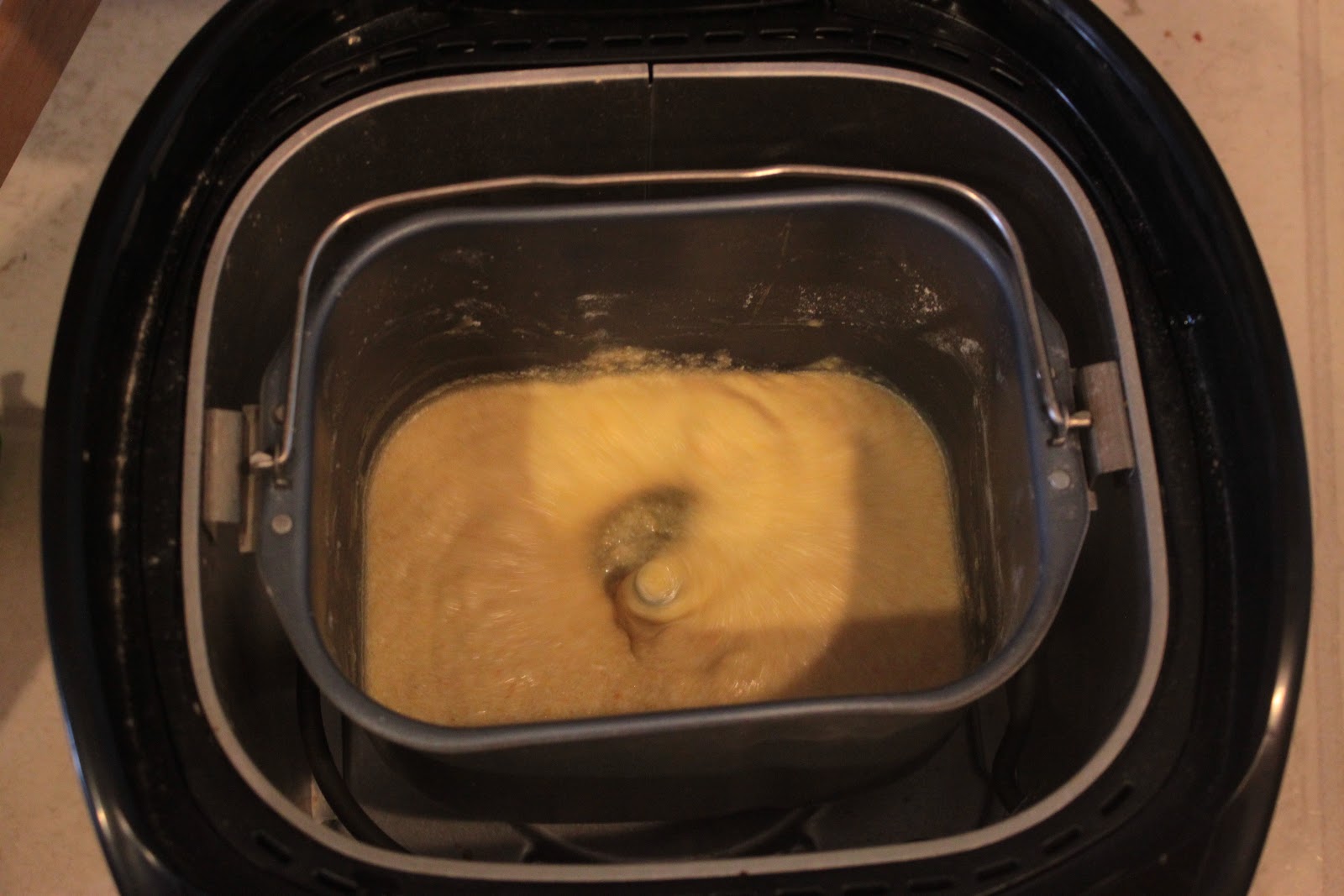
Perhaps your oven is in use with another project, your house is too hot to use the oven, or you simply feel the need to justify your $12 thrift store purchase of a bread machine. All these would be perfect opportunities to use your bread machine to whip up a tasty citrus cake (a copycat of the Starbucks Lemon Loaf). My recipe is based on this one, which might be a better option to try if you're just going to do it in the regular oven.

If your machine has a dough setting and a bake setting, you can basically override the the machine's preprogrammed routines and use it somewhat like an easy-bake oven. I have used a similar method to make cornbread in the bread machine. Some bread machines also have a specific cake setting. I have a Breadman TR875.


Cake:
1 c flour
1/2 c. oatmeal flour
1/2 t baking powder
1/2 t. baking soda
1/2 t. salt
3 eggs
1 c. sugar
2 T. butter, melted
1 t. vanilla
1/3 c. lemon juice
1/2 c. coconut oil, melted
zest of one orange or lemon

Glaze:
1 c. powdered sugar
2 T lemon juice

Put all ingredients in bread machine and put on "dough" cycle. Use a small rubber spatula to help scrape the flour out of the corners and bottoms while it mixes. When thoroughly mixed, cancel the dough cycle, reach in and pull out the mixing paddle, and turn on the "bake" option for approximately 1 hour or until the middle is done. Remove, cool, and pour the glaze over the top.


Monday, February 04, 2013

M: 14 months

While the men were off in Portland, Malachi and I had a fun day. He set foot in the library for the first time (I'm pretty sure I've always held him or had him in the ring sling before) and enjoyed checking out his own books at the self-checkout machine just like Toby always does. He is pretty insistent about doing things a certain way: getting his own hymnal from the pile at church, eating his own food with utensils just like everyone else, and having a bedtime book just like Toby. His favorite bedtime book is the farm book, because it has pictures of blueberries, chickens and puppies. He recently added "woof woof" to his vocabulary and enjoys feeding Toby's stuffed dog.


Wednesday, January 16, 2013

Book Review: Last Child in the Woods

When we bought our house, we were aware that for as long as we live here, out kids will grow up in a different outdoor environment than we did. No "Basil's bushes", no "swamp", no cornfields nearby. We have taken countermeasures...chickens, garden, camping, traveling. And I hope they will grow up having many opportunities to be amazed at God's creation as children and adults.

Last Child in the Woods: Saving our Children from Nature-Deficit Disorder was an interesting read on the results of having a generation of kids growing up disconnected from the natural world they live in, and what some of the solutions might be. It's not just TV and gadgets keeping kids away from nature, it's also the busy society we live in, fear of lawsuits and kidnapping (we feel like we can't let kids play in vacant lots or back woods anymore; many of the risky activities my Dad enjoyed as a child would simply not happen today), organized sports that take kids outdoors but don't give them an opportunity to connect with the natural world, and even environmentalists who work to forbid things like kite-flying, bug collecting, fishing and tree houses in order to "protect" nature. 


The result is children (and eventually adults, because kids grow up, right?) who know a lot of politically correct factoids about recycling and endangered species, but couldn't name most local plants or animals or care about protecting them. Elaine Brooks is quoted in the book saying "people are unlikely to value what they cannot name" (page 41) . I found this interesting in light of man's first task of naming the animals. 

Other societal problems linked with nature deficit are obesity, mental health problems (including skyrocketing depression in preschoolers and young children), lack of creativity, poorer motor skills in children, and a poor foundation for understanding things like the laws of physics. Unstructured outdoor play time (think building forts and mixing mud soup) is the ultimate open-ended toy and helps kids develop skills like setting goals, experimenting, and calculated risk-taking. ADD/ADHD is also an increasingly common diagnosis in today's kids. There are different theories about why this is, but it is noted that increased TV time increases the possibility of kids being diagnosed. Time in nature may not be able to fully prevent attention problems, but there is interesting research showing that when people experience "directed attention fatigue", they become agitated, impulsive, and unable to concentrate. Nature tends to hold our involuntary attention (fascination, the opposite of directed attention) and gives our directed attention a break. We are better able to concentrate after time spent outdoors in nature. 

Chapter 12 asks "Where Will Future Stewards of Nature Come From?"; I liked the wording of this question since I believe humans were given a role of stewardship by God. Many kids today are either scared of nature (because of the fictional or dramatized accounts they see in the media), or bored and let down by nature (because it isn't as exciting as the fictional accounts in the media). Boredom in general, the book contends, is a relatively new concept, culturally. In Medieval times, the state of boredom and listlessness was called Acedia, and it was considered a precursor to sloth, one of the seven deadly sins. Acedia was thought to devalue the world and it's creator. 

Part V of the book (Chapters 16 and 17) talk about how schools and camps can better encourage kids to benefit and learn from nature and natural play. Whether that be lessons, field trips, gardens, or differently designed playgrounds, there are many things schools can do. There is solid research along with anecdotal evidence described in the book. This section of the book was perhaps my favorite, as education is a field I can have an impact on, unlike things discussed in later chapters like city planning and plant genetic research. I would recommend that educators skim through these chapters even if you don't have time to read the whole book. The last book I read (not counting kids' books) was about the educational methods of Charlotte Mason, a British Christian educator who lived in the late 1800s and early 1900s. Among other distinctive ideas, she emphasized spending time outdoors and nature study as a subject. As a Christian, I admire her perspective and how her goal was to keep the love of learning alive. Reading these two books consecutively gave a unique perspective.

I didn't take as many notes on the end of the book...it was late, my pencil was lost, excuses excuses. The section on urban planning offered interesting (if a bit "ecotopian") scenarios of how future development in our country could be designed to allow people, especially children, to benefit from and connect with the physical world of nature. There were also some good examples of existing small and large communities that have done this without turning into hippie communes. Sioux Falls, South Dakota even got a mention as a growing diverse city that some people are moving to, or moving back to, in order to get away from the commotion of the big cities. America has historically valued keeping pockets of open green space within big cities too (for example, New York's Central Park) and planners of new areas can imitate and expand on those traditions.

The last section of the book: "To Be Amazed", discussed the spiritual implications of the disconnect from God's creation. Being as the book is not written from a specifically Christian perspective and quotes a wide variety of people, I found plenty to disagree with. No, I do not think it would be good news if Sunday School started to sound a lot like Ecology 101. I believe that God reveals himself most powerfully in his Word and in his Son; experiences in the beauty and order of God's creation can draw us to praise him, and we are designed to interact with the rest of God's creation, but "nice spiritual experiences" in nature are of no use without Christ. Some of the people quoted in the book elevated nature too much, but I enjoyed the comments from Suzanne Thompson, a "religiously conservative Christian" who is suspicious of the "environmental agenda" and bioegalitarianism, yet realized something had to be done to change her neighborhood. She felt the area was sterile and unsafe for children, so she ripped up her front yard and built a natural-feeling courtyard with Adirondack chairs where neighborhood kids and adults were free to socialize together. Whatcom County, WA (Lynden area), "steeped in Dutch religious traditions" is mentioned on page 300 for it's citizens striving to live out their faith and care for the land they are entrusted with.

This doesn't fit chronologically into my review, but I enjoyed the biographical tidbits about famous people and their experiences with nature as children: Ansel Adams, Beatrix Potter, Ben Franklin, and others that you might not expect were shaped by their early exploration "in the woods".

We'll always be a technology family and I hope my kids are not just proficient, but downright brilliant with a computer. But there will continue to be limits on screen time in our house. After reading this book I would be less likely to choose a computer-based school or curriculum for the kids, and I will be conscious of taking them to natural areas to play, not just structured playgrounds, as well as encouraging creative outdoor play in our own yard space.

What about you? What were your favorite "wild places" as a child and what did you learn there? What are you doing to give the children in your life that same opportunity?

Toby and Grandpa H. at Bateman Island this fall shortly after getting his cast off.

Wednesday, January 09, 2013

Rotating Meal Plan

Every New Year's Resolution is about food, right? I didn't make any hard and fast actual resolutions, but I do have a few food inspirations that I would like to try...things that sound healthy, fun, or just interesting. Sprouts, mozzarella, bottling a batch of pop, kefir!

But it doesn't help to burn yourself out on an über-healthy meal or project, and then the next day have no meal ideas, does it. I have that problem sometimes. I bet you do too.


I have tried, with varying success: making a meal list (ideas that I have the ingredients for on hand) and crossing things off it as I go, using saymmm.com to plan out a week at a time, freezer cooking for a month, and the old "just wing it" method. For January, February, and March I am going to try a 2-week rotating base meal plan. I can always substitute something "more interesting", but at least I have a default idea to fall back on.

When the seasons change I can either make a new 2-week rotation, or ditch this method and do something else. My goals were to aim for not too much dairy, use a moderate (for us) amount of meat, and try to use things like frozen applesauce that tend to get forgotten about in the freezer. There are a variety of recipes and variations that can be used for some of the things like soup, pizza, and stir fry. It may need some tweaking or juggling around yet, but hopefully it is a good start!

Winter Meal Plan Week A
Monday: make a snack, stir fry and rice for supper
Tuesday: make yogurt, burritos or quesadillas for supper
Wednesday: BBQ chicken or pork sandwiches + applesauce
Thursday: Goulash
Friday: Pizza
Saturday: Breakfast for supper (French Toast, Pancakes, Waffles, etc.)
Sunday: Baked Chicken (raspberry, BBQ, basil, or other flavoring) and apple crisp for Sunday dinner


Winter Meal Plan Week B
Monday: make a snack, Soup and bread/biscuits for supper
Tuesday: make yogurt, noodles with chicken or tuna for supper
Wednesday: egg casserole or breakfast burritos
Thursday: Fish + squash or sweet potato
Friday: Pizza
Saturday: lentil taverns or shepherd's pie
Sunday: lasagna